
Crown Refs · Development resources
Basketball Referee Film Study
Do more than decide whether a call was right. Use film to understand how your positioning, coverage, timing and communication shaped the decision—and what you can improve next time.
Start hereReview the possession, not just the contact. Finish with one clear adjustment you can take into your next game.
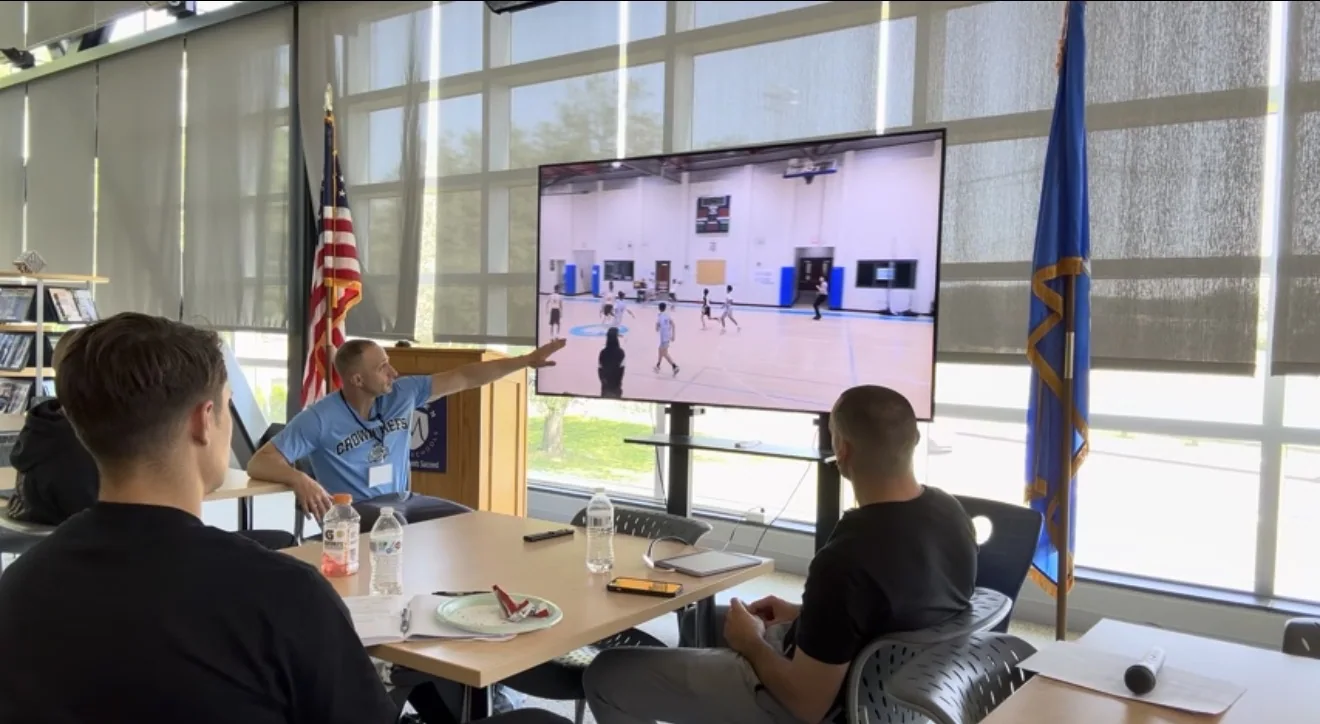
Start with context, not a verdict
Before reviewing a clip, identify the rules used in the game, the crew system, your position and your responsibility on the play. Include the lead-up when it is available. A few seconds before the disputed moment may explain why the official moved or why the view changed.
Watch once at normal speed. Then use pauses and slow motion to study the sequence. The camera may reveal something the official could not see, and a single angle can also hide important action. State what is visible, what is uncertain and which conclusion the footage can actually support.
Use film you have the right to access and share. Follow your league, school, association and platform policies, especially when clips include young players. Keep discussion focused on learning rather than publicly criticizing participants or other officials.
A five-pass film-review process
Separate the pieces of a possession so that the final whistle does not overshadow everything that came before it. This is a suggested practice routine; apply the rules and mechanics used by your competition.
Watch the whole possession
Identify the action developing before the decision. Note the transition, the players involved and where the crew begins.
Check responsibility and the view
What were you responsible for? Could you see the relevant action, or did players move between you and the play? Avoid judging a partner’s coverage from an incomplete angle.
Study the decision
Describe the action before labeling it. Identify the applicable rule and distinguish clear evidence from an assumption. Use the current rulebook or casebook to resolve uncertainty.
Review the response
Watch the signal, reporting, communication and administration that followed. A decision is only one part of completing the play.
Choose a next-game adjustment
Write one behavior you can practice and observe. Compare it with another possession or revisit it after your next assignment.
Ask questions that produce useful feedback
“What do you think?” can start a conversation, but a focused question gives a reviewer a clearer job. Explain the rule set, identify the official or position you want reviewed, and say what you noticed before asking for feedback.
For example: “I was the trail official on this possession. I felt my angle close as the drive developed. What movement would have helped me maintain a view within our mechanics?” The purpose is to examine the process, not to claim that a different position would guarantee a perfect decision.
- Where did my view improve or disappear during the possession?
- Was I watching the action that belonged to my coverage?
- What information did I have at the moment of the decision?
- Was my communication clear after the whistle?
- Which single adjustment is worth testing next?
Keep a short film-study log
Choose a small sample of possessions rather than saving only controversial calls. Include something handled well, something uncertain and a recurring habit. This gives you a more balanced view of your work.
For each clip, record its time, the situation, your observation, the feedback and your next action. Keep descriptions neutral: “My view was blocked at the gather” is more useful than “I had a terrible game.”
Close the loop. After practicing the adjustment, find a comparable possession and ask whether your behavior changed. Film study becomes development when the review influences preparation and on-court habits.
- Clip/time: where can I find the possession again?
- Observation: what can I actually see?
- Question: what needs clarification?
- Next action: what will I practice or change?
- Follow-up: what happened when I tried it?
Choose the right setting for your review
Self-review is a starting point, not the only perspective. A trusted partner or experienced mentor may notice patterns you have missed. A group can help you compare reasoning, provided the conversation remains respectful and grounded in the applicable rules.
Crown Refs offers film-study conversations within its development community, focused film-breakdown sessions and the Individual Performance Report. IPR examines game film and on-court habits to help an official understand areas for development. Check the current service description for the scope and what is included.
Neither a review nor a membership guarantees higher-level assignments. The useful outcome is clearer understanding and a development plan you can put into practice.
From the Crown Refs library
Watch and learn
Go deeper with Al Battista’s film-review conversation on The Crown Refs Podcast. Choose a few questions from the discussion and use them on your own next review; the five-pass exercise above is a separate suggested routine.
21 Questions to help you effectively break down film | with Al Battista | The Crown Refs Podcast 94
Bring your film. Build your next step.
Learn how the Crown Refs Individual Performance Report can support a focused review of your on-court habits.
Explore IPR Film Review